
Swiggy Q4FY26 Results: Food delivery hits 15-quarter high growth, Instamart losses narrow as path to profitability sharpens
Sarthak Kumar
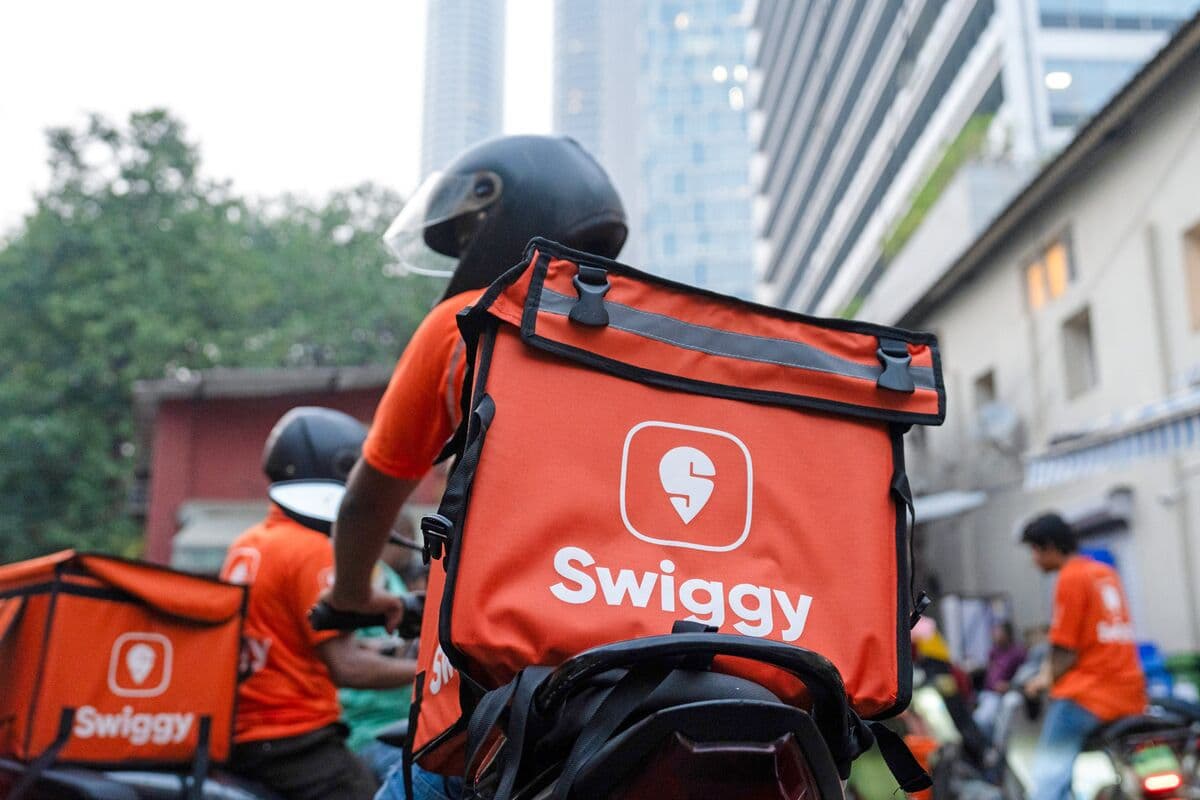
Platform MTUs cross 25 million; CEO Sriharsha Majety warns against discount-led volume chase in quick commerce, bets on differentiation for Instamart's long-term success
Food delivery platform Swiggy posted its strongest quarterly performance in nearly four years, with food delivery gross order value (GOV) growing 22.6% year-on-year to ₹9,005 crore in Q4FY26, surpassing its own guided range of 18–20%. The result marks a 15-quarter high growth rate, driven by rising order volumes and monthly transacting users rather than higher average order values — a distinction that management flagged as evidence of durable demand momentum.
At a consolidated level, adjusted revenue grew 41.3% YoY to ₹6,665 crore, while the platform's monthly transacting users (MTUs) reached 25.2 million, up 27.2% year-on-year. Adjusted EBITDA losses narrowed sequentially by ₹60 crore to ₹652 crore for the quarter, with the B2C adjusted EBITDA margin improving 181 basis points YoY to -3.0% of GOV.
Food delivery: Margin record, competition response
Food delivery posted its best-ever adjusted EBITDA margin of 3.3% of GOV, up 26 basis points quarter-on-quarter, with absolute EBITDA at ₹297 crore. The company attributed the improvement to advertising-led revenue growth, delivery cost efficiencies from higher order density, and a deliberate shift away from discount-driven demand toward what it described as a utility-led value proposition built around Bolt, 99-Store, and One BLCK.
On competitive pressures from new entrants in food delivery, CEO Sriharsha Majety struck a composed tone in his shareholder letter. He argued that Swiggy had pre-emptively addressed the openings new entrants typically target — affordability through 99-Store and Toing, speed through Bolt and One BLCK, and health through Eat Right. The company reiterated its medium-term adjusted EBITDA margin guidance of 5% of GOV, maintaining that its profitability drivers — advertising monetisation scale and delivery cost leverage — are structurally independent of short-term competitive cycles.
Instamart: Losses narrow, differentiation becomes the thesis
Swiggy's quick commerce arm, Instamart, remained loss-making but showed measurable improvement. GOV grew 68.8% YoY to ₹7,881 crore, while the contribution margin improved 65 basis points sequentially to -1.8% of GOV. Notably, the monthly contribution margin for March 2026 stood at -1.1%, keeping the company on track for its publicly stated goal of contribution margin breakeven by Q1FY27. Adjusted EBITDA losses narrowed to ₹858 crore from ₹908 crore a quarter ago.
Majety was direct about the strategic fork in quick commerce. With the market growing increasingly commoditised, he said every platform must choose between being convenience-led or price-led, and Swiggy has firmly chosen the former. The company is positioning Instamart as a destination for everyday lifestyle upgrades rather than just essentials, with its clean-label private brand Noice cited as an early proof point.
The company shut down its quick food experiment, Snacc, during the quarter, citing unviable unit economics at scale. Toing, its affordable restaurant marketplace targeting budget-conscious consumers, remains in experimentation mode.
Cash position, gig worker disclosures
Swiggy's consolidated cash and cash equivalents stood at ₹15,053 crore as of March 31, 2026, providing a significant runway. Capex was ₹188 crore for the quarter, expected to trend lower in FY27 as dark store and warehousing infrastructure build-out matures. The company also disclosed that approximately 100,000 delivery partners have registered on the government's E-Shram portal, unlocking access to insurance and pension benefits under the Code on Social Security, 2020.